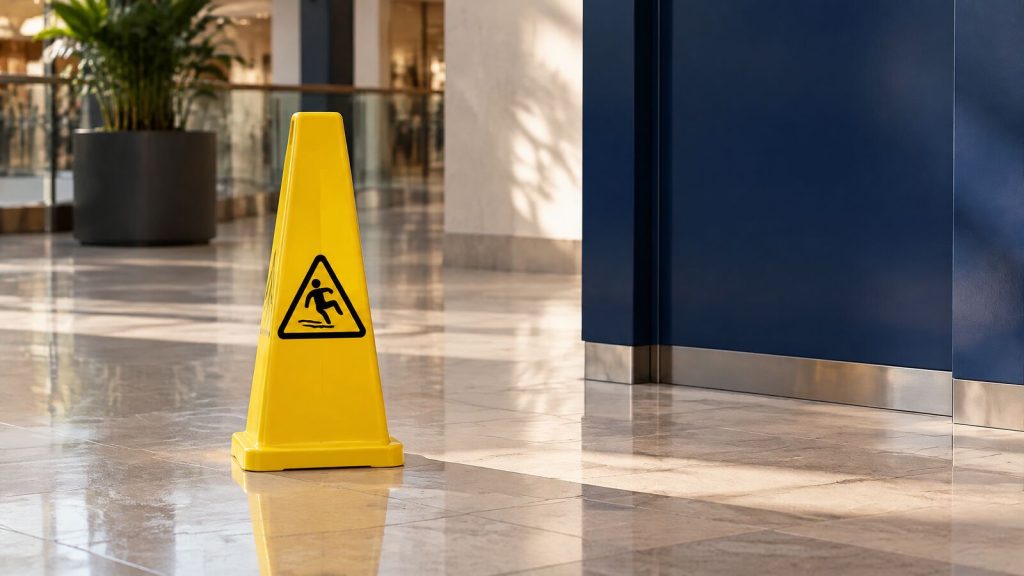
Slip and fall injuries in Queensland: your rights after a fall in a shop, car park or on a footpath
In Queensland, a fall on its own does not make anyone else legally responsible, but you may have a claim if the person or business in control of the place did not take reasonable care and that caused your injury. The law also sets notice steps before any court case, and time limits.
By Catton Roderick LawyersLast reviewed 12 min read
General information about Queensland law. Not legal advice. Law checked against the Acts in force on 25 September 2026.
A fall in a shop, a car park or on a footpath can cause a serious injury. In Queensland, you may have a claim if the fall happened because the person or business in charge of the place did not take reasonable care. This guide explains how the law decides that, the steps the law sets before any court case, the time limits, and what to do now.
Can you make a claim after a slip or fall in Queensland?
Sometimes. A fall on its own does not make anyone else legally responsible. Under the Civil Liability Act 2003 (Qld), you generally need to show that the person in control of the place did not take reasonable precautions against a risk they knew about, or ought to have known about, and that this failure caused your injury. The three tests are set out below.
How a court decides if someone was careless
A person does not breach a duty to take precautions against a risk of harm unless (section 9(1)):
(a) the risk was foreseeable (that is, it is a risk of which the person knew or ought reasonably to have known); and
(b) the risk was not insignificant; and
(c) in the circumstances, a reasonable person in the position of the person would have taken the precautions.
For the third test, the court weighs, among other things, how likely the harm was if care was not taken, how serious it was likely to be, how hard or costly precautions would have been, and the social value of the activity that created the risk (section 9(2)).
Showing the fall caused your injury
Causation has two parts: the breach must have been a necessary condition of the harm (factual causation), and it must be appropriate for the liability of the person in breach to extend to the harm (scope of liability) (section 11(1)). The injured person must prove every fact about causation on the balance of probabilities, meaning more likely than not (section 12).
Situations the law can cover
For example, these rules can apply to:
a spill left on a supermarket floor
a broken or lifted paver on a footpath
a pothole or uneven surface in a car park
loose matting or poor lighting on stairs in a building open to the public.
Whether any of these leads to a claim depends on the tests above.
Who is responsible for a fall in a shop, car park or on a footpath?
Usually the person or business in control of the place where you fell. That can be a shop or supermarket, the owner or manager of a shopping centre, a car park operator, a cleaning or maintenance contractor, a landlord, or a council. More than one party can be involved. The same negligence tests apply to each, but councils and other public authorities have extra protections under the Civil Liability Act.
Shops, shopping centres and car parks
Who controlled the area where you fell matters. The written notice of claim required by the Personal Injuries Proceedings Act 2002 (Qld) (PIPA), explained below, goes to the party you propose to sue. If others may also be responsible, the party that receives Part 1 of the notice must copy it to each other party it knows of and tell you who it sent copies to and why, unless you have told it in writing that you have given, or will give, the copy yourself (PIPA section 9(7) and (7A)).
Council footpaths and roads
A local government is a “public or other authority” under the Civil Liability Act (section 34). The court considers the resources reasonably available to the authority and the broad range of its activities, and the authority can rely on evidence that it followed its general procedures and any applicable standards (section 35). If a claim is based on how an authority used, or failed to use, one of its functions, the act or failure must have been so unreasonable that no authority with those functions could properly consider it reasonable (section 36(2)).
An authority acting as a road authority is also not liable for failing to repair a road or keep it in repair, or to inspect it for that purpose, unless it had actual knowledge of the particular risk that caused the harm (section 37(1) and (2)). The Act takes the meaning of “road” from another Queensland Act (section 37(3)). This rule protects only an authority acting as a road authority, not a private car park operator.
For a claim against the State, or an entity with the State’s privileges and immunities, Part 1 of the notice is effective only if it is given to the Crown solicitor and names the department or entity you consider responsible (PIPA section 9(8)).
Rental properties
A landlord or property manager may owe a duty of care to tenants and visitors.
When a different scheme applies
If you were hurt at work and WorkCover compensation is payable for the injury, the Civil Liability Act generally does not apply (section 5(1)(b)). A damages claim against your employer then follows the pre-court steps in the Workers’ Compensation and Rehabilitation Act 2003 (Qld). A claim against someone else, such as the business in control of the place, still follows the PIPA steps (PIPA section 6(2)(c) and its example). See WorkCover common law claims.
If a motor vehicle caused the injury, the compulsory third party (CTP) scheme under the Motor Accident Insurance Act 1994 (Qld) may apply instead (PIPA section 6(2)(a)). See CTP claims in Queensland.
What if the risk was obvious, or you were partly at fault?
Both can affect a claim. There is generally no duty to warn you of an obvious risk, meaning one that would have been obvious to a reasonable person in your position. A court can also reduce your damages, by as much as 100%, if you did not take reasonable care for your own safety. If you were intoxicated and the other side alleges you were partly at fault, that is presumed, and you can rebut it only on limited grounds.
Obvious and inherent risks
An obvious risk, as defined above, includes a risk that is patent (plain to see) or a matter of common knowledge (Civil Liability Act section 13(1) and (2)). The no-duty-to-warn rule has exceptions, including where you asked for advice or information about the risk, or a written law required a warning (section 15). A risk created by a failure to properly operate, maintain, replace, prepare or care for a thing is not an obvious risk, unless the failure itself is an obvious risk (section 13(5)).
No one is liable in negligence for harm from an inherent risk: a risk that cannot be avoided by the exercise of reasonable care and skill. That rule does not remove any duty to warn of the risk (section 16).
Contributory negligence
Contributory negligence means the injured person failed to take precautions against the risk of their own harm. You are judged by the same standard as the other party: a reasonable person in your position, based on what you knew or ought reasonably to have known at the time (section 23). A court can reduce your damages, and may decide a reduction of 100% if it considers that just and equitable, which defeats the claim (section 24). If you were intoxicated at the time of the breach of duty and the other side alleges contributory negligence, it is presumed (section 47(1) and (2)). You can rebut it only by showing, on the balance of probabilities, that the intoxication did not contribute to the breach of duty or was not self-induced (section 47(3)). Otherwise your damages are reduced by 25% or a greater percentage the court decides (section 47(4)).
What should you do after a fall?
Get medical treatment first, and tell the doctor how the fall happened. Report the fall to the business, centre management or council in writing, and keep a copy. If you can, take photos of the place and the hazard, write down what happened while you remember it, and note any witnesses. These records help show what happened if you later decide to claim.
A short checklist:
Medical treatment, and your medical records.
A written incident report, and a copy for you.
Photos of the hazard, the lighting, any signs and your shoes.
Witness names and contact details.
A written request that the business keep any CCTV footage.
Receipts for your costs, and records of time off work.
How does a slip and fall claim work in Queensland?
Before a court case can start, the Personal Injuries Proceedings Act 2002 (Qld) sets pre-court steps. You give the party you say is responsible a written notice of claim in the approved form, in two parts. Generally within 6 months of a complying Part 1 notice, they must admit or deny liability and make or answer a settlement offer. If the claim does not settle, the parties generally hold a compulsory conference before any court case.
The pre-court steps for a public liability claim in Queensland
Step
What happens
Time the Act sets
Where the Act says so
1. Notice of claim, Part 1
Written notice in the approved form to the party you propose to sue
By the earlier of 9 months after the fall (or, if symptoms were not immediately apparent, after they first appeared) and 1 month after you first instruct a law practice (a law firm) and that party is identified
The party admits or denies liability, states any contributory negligence it claims as a percentage, estimates your damages and makes or answers an offer
Generally within 6 months of a complying Part 1 notice
Required before any court case, unless the parties or the court dispense with it for good reason
At a time the parties agree, or called by any party after the “relevant day”: the later of 6 months after a complying Part 1 notice and 6 months after the party confirms it is the right respondent
Some periods can be changed by regulation, so check the current rules for your claim.
If there is an urgent need, the court can give leave to start a court case before the steps are finished. The case is then generally paused until they are done (section 43(1) and (3)), with one narrow exception (section 43(4)).
The two time limits, in brief
Two time limits apply. Part 1 of the notice of claim is generally due within 9 months after the fall, or within 1 month after you first instruct a law practice and the party responsible is identified, if that is earlier (PIPA section 9(3)). Separately, a court case generally has to start within 3 years from the date the cause of action arose (Limitation of Actions Act 1974 (Qld), section 11(1)).
If a claim succeeds, damages are meant to cover losses the injury caused, such as pain and suffering (called general damages), lost earnings, and costs such as treatment. For general damages, a Queensland court gives the injury a score from 0 to 100, called an injury scale value, using rules in a regulation and similar past cases. A government notice then sets the amount for each score.
General damages means damages for pain and suffering, loss of amenities of life (losing the ability to do or enjoy things you could before), loss of expectation of life and disfigurement (Civil Liability Act section 51). The scale and how the court assesses it are set out in section 61(1). The Minister fixes the amounts for each score in a notice made before each financial year starts, and the amounts used are those for the period in which the injury arose (sections 62(2) and (4) and 75(1)).
Frequently asked questions
Do you have to go to court to make a public liability claim?
Not always. PIPA requires the pre-court steps and a compulsory conference before a court case (section 36(1)), unless the parties or the court dispense with the conference for good reason (sections 36(4) and 36(5)(b)). The Act aims to promote settlement of claims at an early stage wherever possible (section 4(2)(b)). Whether a claim settles depends on the facts.
How long does a public liability claim take?
PIPA sets no total time, only periods for each step, such as generally 1 month for the first response to Part 1 and 6 months for the response on liability (sections 10(1) and 20(1)). How long a claim takes overall depends on the facts, including the injury.
Can you claim against someone’s public liability insurance?
The notice of claim goes to the person or business you propose to sue (PIPA section 9(1)). It authorises that person, and their insurer for the claim if they are insured against it, to access records and sources of information relevant to the claim (section 9(2)(b)).
What if a child was hurt in a fall?
A parent or legal guardian may give the notice of claim for the child (PIPA section 9(4)). The court time limit works differently for children, as explained in time limits for children.
Talk to us about a personal injury matter
To talk to Catton Roderick Lawyers about a personal injury matter, call 1300 673 792 or email info@cattonroderick.com.au. Our offices are at Unit 3, 9 East Street, Caboolture, and First Floor, Cominos Arcade, 133 Redcliffe Parade, Redcliffe. We also see clients in Birtinya (Sunshine Coast) and Brisbane by appointment.
This page is general information about Queensland law as at September 2026. It is not legal advice about your situation. Time limits apply, so please get advice about your own circumstances.
Sources
Law checked on 25 September 2026 against the versions in force on that date.
Catton Roderick Lawyers acts in wills and estates, estate claims, personal injury and commercial law in Queensland. Call 1300 673 792 or send us a message through our contact page.
Caboolture – Mon to Fri - 9am to 5pm - Closed Sat, Sun,
Redcliffe – Tues to Fri – 9am to 5pm - Closed Sat, Sun, Mon
Sunshine Coast - By Appointment Only
Content, including images, displayed on this website is protected by copyright laws. Downloading, republication, retransmission or reproduction of content on this website is strictly prohibited.